
The most common roofing problems on Highland Park homes are wind-lifted or missing shingles, hail bruising and granule loss, failed flashing around chimneys and vents, blocked valleys and gutters, and ordinary age-related wear. Most are repairable when caught early. A ceiling stain means the leak has been running for weeks and needs inspection within days.
A roof rarely fails all at once. It fails at one edge, one seam, or one flashing joint, and stays quiet until water reaches the drywall. Which failure you have decides whether this is a repair or a replacement.
What Storm Season Leaves Behind on Highland Park Roofs
Wind and hail cause more roof damage in North Texas than age does, and it lands in patches.
Lifted and Missing Shingles
Wind works at the edges. Rakes, eaves, and ridge caps sit where uplift pressure is highest, so a gust that leaves the middle of a slope untouched can peel a strip along one border. Once a tab lifts, the next course loses its seal, and the failure widens with every storm.
Hail Bruising and Granule Loss
Hail bruising is impact damage that crushes the asphalt mat beneath the granule surface without always breaking through it, so from the driveway it looks like nothing. The ground-level tell is granule accumulation in gutters and downspouts, which means the mat underneath is aging faster than it should.
Why Flashing Leaks Before the Shingle Field Does
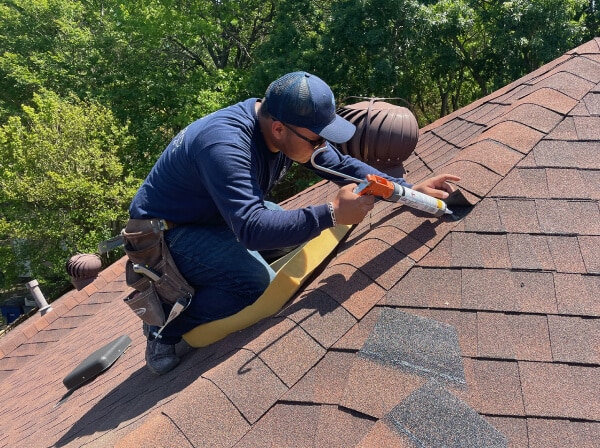
Flashing is the metal that seals every joint where a roof meets something else: a chimney, a wall, a vent pipe, a valley. It is where most leaks start, because it is the one part of the assembly that depends on a seal rather than overlap.
The code treats it that way. Section R903.2 of the 2024 International Residential Code requires flashing to be installed so that moisture cannot enter the wall or roof through joints, through moisture-permeable materials, or at intersections with parapet walls and other penetrations. Sealant cracked by the sun no longer meets that standard.
Flashing failure is also hard to catch, because the water it admits travels along the decking before it drips, so the stain appears several feet from the entry point.
Where Trapped Water Sits After a Highland Park Downpour
Water that cannot leave the roof quickly has time to find a weakness. The National Weather Service Fort Worth and Dallas office puts the 1991 to 2020 annual precipitation normal for its Fort Worth station at 37.98 inches, October being the wettest month at 4.60 inches, much of it arriving in short heavy bursts.
Highland Park’s mature tree canopy supplies the other half. Leaf litter packs into valleys, where water backs up under the courses on either side, and fills gutter runs until they spill at the front edge instead of reaching a downspout. Gutters that overflow in an ordinary rainstorm point to a drainage problem, which is why our gutter repair and installation work in Highland Park starts with pitch and downspout capacity.
How Fast Does a Roof Age in North Texas Heat?
Faster than the rated life on the shingle wrapper suggests, because that rating assumes adequate attic ventilation and a moderate thermal load. Age shows itself as a pattern rather than an event: curling at the corners, thermal splitting across the field, and granule loss spread evenly rather than concentrated in one impact zone. Ventilation is not optional on a Texas roof, it stops the deck from cooking the covering from below.
Highland Park Roof Symptoms, Likely Causes, and the Usual Fix
| What you see | Likely cause | What the fix involves |
|---|---|---|
| Granules in gutters and downspouts | Hail impact or surface aging | Inspection to tell bruising from wear |
| Shingle tabs lifted along one edge | Wind uplift at a rake, eave, or ridge | Replace the courses, check fastening across the roof |
| Ceiling stain with no damage above it | Failed flashing at a chimney, vent, or valley | Trace the entry point, reseal or replace the metal |
| Water spilling over the gutter front | Blocked valley or lost pitch | Clear the run, re-hang and re-pitch, add downspout capacity |
Reroofing in Highland Park Means Working Under the 2024 Residential Code
This is where Highland Park parts company with the rest of the Dallas area. The Town adopted the International Residential Code, 2024 edition, by Ordinance 2159 on January 6, 2026, replacing the 2021 edition. That adoption sits in Article 3.08 of the Town of Highland Park Code of Ordinances, which also requires a building permit for the work. A contractor quoting the 2021 IRC is quoting a superseded edition here, and fastening, underlayment, and flashing details are where editions change.
At Acorn Roofing and Construction, we pull permits for Highland Park work and build to the edition the town has adopted. Most storm damage really is repairable, which is what our roof repair service in Highland Park exists for. A full roof replacement is what we recommend once patching stops making sense.
One Customer on the Flashing Her Previous Roofer Left Alone
Not every call involves new damage. Some involve details another company skipped, where the shingle field looks right from the street but the chimney joints were never sealed. Sue Woodfield, a Texas homeowner, came to us that way.
“The company was fast and efficient. They replaced flashing and sealed around the chimney and other locations that the previous roofing company had neglected. Super polite and professional workers!”
Her review shows the sequence every flashing call gets from us: find each penetration that has lost its seal, not just the one nearest the stain. Read Sue’s review on Google.
Bring Us Out Before the Next Line of Storms
Book an inspection while the damage is still small enough to repair. We photograph what we find and price the work before it starts, and you can see the rest of what we do on our Highland Park service area page. One last thing: do not climb up to look yourself, because storm-damaged decking is unstable and hail-struck shingles are brittle underfoot.
Frequently Asked Questions About Roofing Problems in Highland Park
Do I need a permit to replace a roof in Highland Park, Texas?
Yes. The Town of Highland Park requires a building permit for residential roofing work, and its residential code adopts the International Residential Code, 2024 edition, under Ordinance 2159. Permitted work is inspected work, and a bid treating the permit as optional is a bid to skip the inspection that protects you against fastening and flashing shortcuts.
What does hail damage look like on an asphalt shingle roof?
Hail leaves circular bruises where the impact crushed the mat under the granule surface. From the ground, that is nearly invisible, so granules in the gutters and dents on vents and flashing are the more reliable signals. Soft spots that give under pressure confirm it during an inspection.
How can a roof leak stain a ceiling far from where the water gets in?
Water entering at a flashing joint or a lifted shingle runs along the decking until it finds a gap, which can carry it several feet before it drips. Diagnosis therefore starts upslope, usually at flashing around a chimney, vent, or valley, rather than above the stain. Cutting into the ceiling first finds the destination and not the source.
How often should a roof in North Texas be inspected?
Twice a year, plus once after any storm that brought hail or damaging wind to your street. Spring and fall checks catch lifted shingles, cracked sealant, and blocked valleys while they are still small repairs. Past 10 years old, tracking curling and granule loss shows when to plan a replacement.
Key Takeaways
- The roofing problems we see most on Highland Park homes are wind-lifted shingles, hail bruising, failed flashing, blocked drainage, and heat-driven aging.
- Wind damage concentrates at rakes, eaves, and ridge caps, where uplift pressure is highest.
- Granule accumulation in gutters is the most reliable ground-level sign of hail impact.
- Section R903.2 of the 2024 International Residential Code requires flashing to be installed so moisture cannot enter through joints or at penetrations.
- Water travels along the decking before it drips, so a ceiling stain is rarely below the entry point.
- Highland Park adopted the 2024 IRC by Ordinance 2159 on January 6, 2026, and requires a permit for roofing work.